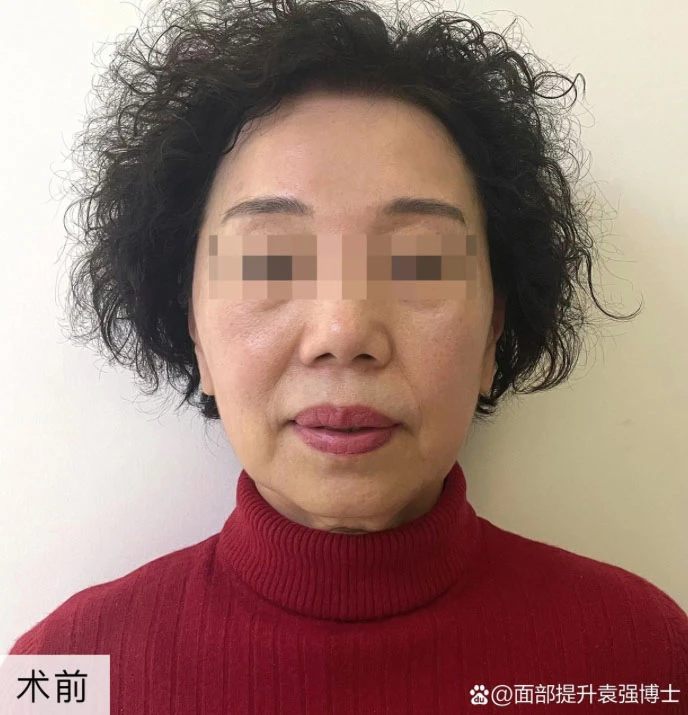
This patient is from Guangxi. She traveled from Guangxi for consultation and surgery 80 days ago. Based on her actual facial condition, we formulated a surgical plan combining mid and lower facelift and autologous fascia augmentation for nasolabial base.
I last met her on the 9th day after surgery, right after suture removal. At that time, her face still had mild swelling and bruising, and facial contours had not fully smoothed out-this was a normal early-stage postoperative recovery state. Though the final aesthetic outcome had not yet emerged, she maintained a calm mindset, remained patient throughout recovery, and actively complied with all postoperative care instructions.
She returned to the clinic for follow-up review 80 days later. While sorting materials, we pulled up her preoperative photos taken during the initial consultation. Seeing her previously lax and sagging facial tissues, she sighed sincerely, expressing immense gratitude that she made up her mind back then and did not easily retreat due to her age, others' gossip, or preoperative anxiety about surgery.
At present, all facial swelling and bruising have completely subsided. The lax skin on her mid and lower face has been precisely tightened, sagging folds significantly improved, and nasolabial base depression naturally augmented. Her facial contour is firm and smooth, presenting a naturally refined youthful appearance.
Confident and poised now, she is willing to share her transformation experience, hoping to offer reference and encouragement to peers facing similar facial aging concerns.
Longtime followers may know that we treat numerous elderly patients. The most common question raised is: Does surgical risk rise for patients aged 70 and above? Objectively speaking, physical functions generally decline after 70, so surgical risks are slightly higher compared with younger patients under 70.
For this reason, we implement a stricter preoperative screening protocol for elderly patients. Beyond routine preoperative physical examinations, we add specialized tests including liver, heart, spleen and kidney ultrasonography and chest CT to comprehensively evaluate physical fitness and rigorously verify surgical indications. Any candidate failing physical assessment will be advised against surgery, mitigating surgical risks from the source.
Regarding concerns over anesthesia safety, our hospital employs full-time, highly experienced anesthesiologists. They continuously and accurately monitor vital signs including heart rate, blood pressure, respiration and body temperature throughout the procedure, dynamically adjusting anesthesia protocols to ensure safety at all times. Judging from clinical cases, elderly patients who pass stringent preoperative screening achieve smooth postoperative recovery with stable, satisfactory aesthetic results.